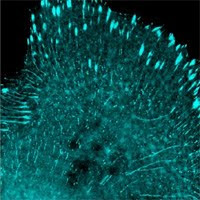
The success of inducing pluripotency in primary fibroblasts and other cells with a combination of only a small number of transcription factors suggested that fully differentiated cells might change fate following similar treatments. Since the demonstration of induced pluripotent stem cells (iPSCs), at least three examples have been published where 3 cell type-specific factors were selected from a pool of 10-20 candidates that, when expressed from viral vectors, could induce beta-cells, neurons, or cardiomyocytes.
Induced beta-cells [1]: Ngn3, Pdx1, and Mafa, adenovirus injected to in vivo targets
Induced neurons (iN) [2]: Ascl1, Brn2, and Myt1l, lentivirus infecting mouse embryonic fibroblasts (MEF) or tail tip fibroblasts (TTF)
Induced cardiomyocytes (iCM) [3]: Gata4, Mef2c, and Tbx5, lentivirus infecting cardiac fibroblasts or TTF
In all 3 cases, the change of fate seemed to be via direct conversion, without passing through a progenitor cell fate before further differentiation. Like iPSC reprogramming, direct reprogramming also requires a transient supply of inducing factors. Unlike generating iPSCs, the percentage of cells getting reprogrammed is much higher in direct reprogramming, ~20% in the cases of iN and iCM vs 0.1-1% in iPSC. It is likely that a transient, inductive expression of essential factors jump-starts endogenous factors to establish cell fate specific programs; it has also been illustrated that chromatin remodeling through DNA methylation, histone modifications, etc. accompanies the direct reprogramming events.
Read the complete story and this week's official post and new product of the week, weekly promotion, etc, go here.
Showing posts with label mef. Show all posts
Showing posts with label mef. Show all posts
Sunday, August 22, 2010


Friday, March 5, 2010
How to Generate Conditional Knockout Mice with Cre
From AlleleBlog: http://allelebiotech.com/blogs/2010/03/how-to-generate-conditional-knockout-mice-with-cre/
The bacterial Cre recombinase targets a specific DNA sequence called loxP and deletes a segment of DNA flanked by loxP sequences. This system is often used in the generation of knockout and conditional knockout animals.
The knockout of specific genes leading to embryonic lethal phenotype will not yield adult animals. Cre-lox recombination provides a means to knockout the specific genes in adult mice, or to introduce a knockout phenotype in specific tissues (conditional knockout) using tissue-specific promoter driven Cre or an inducible Cre.
The cutting by Cre at the loxP sites and rejoining by ligase is an efficient process. During this process, inverted loxP sites will result in an inversion, whereas direct repeat will cause a deletion. Cre/lox recombination is a one-way reaction so there is no need for continued Cre expression. Therefore, Cre can be introduced by adenovirus or lenti/retrovirus. Here is an example of using adnovirus-Cre in one lab: for MEF, on a 70% confluent P10 cm plate (probably 2-2.5 million cells), use 6ul of 1.1×10^12 adenovirus-Cre, which will give 80% infection; or use 10ul of 1.1×10^12 adenovirus-Cre to get 90% infection, with GFP as marker and analyzed by FACS.
Adenovirus could post a toxicity problem when used at the very high titers to reach high percentage of transduction. An alternative is to use only lentivirus-Cre, at only about 1-2 ul and still obtain >80% infection. However, a silencing event needs to occur before the expression of Cre from lentivirus is shut off. The timing and degree of silencing is not controlled in such experiments. Continued expression of Cre should not influence most experiments.
To be certain that the Cre enzyme can be successfully delivered into the nucleus for conditional knockout to occur, the bacterial Cre gene needs to be engineered to contain a nuclear localization (nl) signal of eukaryotic cells. The function of the nuclear-localized Cre (nlCre) can be tested using a loxP-nuclear localized lacZ (nlacZ) reporter cell line, which can be used to monitor the function of the nlCre recombinase.
New Product of the Week 03-01-10 to 03-07-10: Lentivirus-Cre ABP-RP-TLCCreS and ABP-RP-TLCCreL, link: http://www.allelebiotech.com/shopcart/index.php?c=219&sc=188.
Promotion of the Week 03-01-10 to 03-07-10: for a limited time, get lab agarose at ~1/5 of the big company’s price. http://www.facebook.com/#!/pages/San-Diego-CA/Allele-Biotechnology-and-Pharmaceuticals-Inc/78331924957
The bacterial Cre recombinase targets a specific DNA sequence called loxP and deletes a segment of DNA flanked by loxP sequences. This system is often used in the generation of knockout and conditional knockout animals.
The knockout of specific genes leading to embryonic lethal phenotype will not yield adult animals. Cre-lox recombination provides a means to knockout the specific genes in adult mice, or to introduce a knockout phenotype in specific tissues (conditional knockout) using tissue-specific promoter driven Cre or an inducible Cre.
The cutting by Cre at the loxP sites and rejoining by ligase is an efficient process. During this process, inverted loxP sites will result in an inversion, whereas direct repeat will cause a deletion. Cre/lox recombination is a one-way reaction so there is no need for continued Cre expression. Therefore, Cre can be introduced by adenovirus or lenti/retrovirus. Here is an example of using adnovirus-Cre in one lab: for MEF, on a 70% confluent P10 cm plate (probably 2-2.5 million cells), use 6ul of 1.1×10^12 adenovirus-Cre, which will give 80% infection; or use 10ul of 1.1×10^12 adenovirus-Cre to get 90% infection, with GFP as marker and analyzed by FACS.
Adenovirus could post a toxicity problem when used at the very high titers to reach high percentage of transduction. An alternative is to use only lentivirus-Cre, at only about 1-2 ul and still obtain >80% infection. However, a silencing event needs to occur before the expression of Cre from lentivirus is shut off. The timing and degree of silencing is not controlled in such experiments. Continued expression of Cre should not influence most experiments.
To be certain that the Cre enzyme can be successfully delivered into the nucleus for conditional knockout to occur, the bacterial Cre gene needs to be engineered to contain a nuclear localization (nl) signal of eukaryotic cells. The function of the nuclear-localized Cre (nlCre) can be tested using a loxP-nuclear localized lacZ (nlacZ) reporter cell line, which can be used to monitor the function of the nlCre recombinase.
New Product of the Week 03-01-10 to 03-07-10: Lentivirus-Cre ABP-RP-TLCCreS and ABP-RP-TLCCreL, link: http://www.allelebiotech.com/shopcart/index.php?c=219&sc=188.
Promotion of the Week 03-01-10 to 03-07-10: for a limited time, get lab agarose at ~1/5 of the big company’s price. http://www.facebook.com/#!/pages/San-Diego-CA/Allele-Biotechnology-and-Pharmaceuticals-Inc/78331924957
Subscribe to:
Posts (Atom)

 Posts
Posts