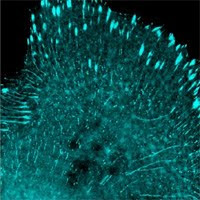
From AlleleBlog: http://blog.allelebiotech.com/2012/08/choosing-the-right-fluorescent-protein/
In 1994 the green fluorescent protein cloned from Aequorea victoria
became the first in a long line of genetically encoded labels. Since
that time, the fluorescent protein palette has expanded to cover the
entire visual spectrum. With so many color variations and options, which
fluorescent protein (FP) is best for your research? Three key factors
are among the most important to consider: brightness, photostability,
and aggregation.
Brightness is the most obvious factor that most researchers consider
when choosing an FP. In general, the brighter the FP, the better it
will perform under almost all experimental conditions. When evaluating
an FP’s brightness, make sure to look at the critical optical parameters
— extinction coefficient and quantum yield. The product of these two
values for different FPs can be used to directly compare their
brightness. Brighter FPs will have lower detection limits (i.e. the
concentration at which the FP becomes visible above autofluorescence of
other cell components), and will allow imaging with lower excitation
light intensity, minimizing the possibility of phototoxic effects.
Photostability has increasingly become a consideration when
researchers choose fluorescent proteins. Many FPs, even if they are
initially quite bright, will photobleach under continuous excitation
during imaging. In order to perform long-term imaging experiments or to
do quantitative analysis, an FP with high photostability should be the
first choice. Unfortunately, methods for measuring and reporting
photostability vary widely in the scientific literature, so be sure to
understand how your FP’s photostability was measured before trying to
make comparisons!
Aggregation (or oligomerization) has been one of the major issues
tackled in the development of FPs. Many wild-type FPs form tetramers,
which aggregate badly when expressed as fusion tags in cells. Engineered
monomeric forms of many FPs are now available, and these monomeric FPs
should always be used when making fusion constructs. For simple
expression markers, however, oligomerization is not usually a major
concern, and the brightest possible FP should be used in this case.
As with other research tools, doing your homework and reading the
primary literature is always the best approach to choosing the right FP
for your project!
Showing posts with label FPs. Show all posts
Showing posts with label FPs. Show all posts
Saturday, August 11, 2012


Friday, July 30, 2010
Allele’s pallet of the super star fluorescent proteins
From AlleleBlogs
http://allelebiotech.com/blogs/2010/07/alleles-pallet-of-the-super-star-fluorescent-proteins/


http://allelebiotech.com/blogs/2010/07/alleles-pallet-of-the-super-star-fluorescent-proteins/
“Photoblog”–just some fun pictures from our notebooks.
- The brightest cyan, green fluorescent proteins, and the brightest ever FP in LanYFP!

Ain't they pretty?
These fluorescent proteins are representatives of the growing family or high quality, new generation FPs engineered to enable experiment previously deemed impossible.
- Cells infected with lentivirus carrying mWasabi. Lentivirus carrying LanYFP will make most cells much more brighter than this.

The mWasabi is stimulating
The brightest green fluorescent protein with excellent photostability, carried on 10e8 TU/ml high titer lentivirus.
- The LanFPs express well in bacteria.

The LanFPs express well in bacteria
Project planning is under way to test the cytotoxicity of lanFPs in different mammalian cell lines and in vivo with a focus on neurons.
- The FPs fold so strongly that they fluorescence even in SDS-PAGE.

Can you see the FP bands in the SDS PAGE?
- FPs in SDS PAGE–a closer look

Can you see them now?
- FPs in gel cassette over UV lights

Invincible FPs
- FPs in gel cassette under blue LED

Fluorescence in SDS page under blue LED
The purified FPs can be used as “real time” protein markers.
New Product of the Week 07/26/10-08/01/10: pCHAC-mWasabi-C for expressing mWasabi fusion through retroviral vectors.
Promotion of the Week 07/26/10-08/01/10: Get 3′ TAMRA & BHQ oligo mods for $45 ea & 3′ Dabcyl mod for $20 50 nmol syn scale only/while supplies last- use dbtkrm0726
Thursday, June 24, 2010
Brightest Ever Fluorescent Protein
http://allelebiotech.com/blogs/2010/06/brightest-ever-fluorescent-protein-2/
LanYFP, identified from lancelet (also known as amphioxus, e.g. Branchiostoma floridae), has been found to have the following properties:
Excitation 513nm
Emission 524nm
Quantum yield 0.95
Extinction coefficient 150,000
pKa ~3.5
Salt insensitive 0-500mM NaCl
LanYFP has a brightness of 143! For comparison, the brightness of the previously known brightest FPs is 95 for tdTomato, and 34 for commonly used EGFP.
Allele already has been exclusively providing the brightest cyan FP in mTFP1 (brightness of 54); and the brightest green FP in mWasabi (brightness of 56). The confirmation of LanYFP as the brightest ever FP is a major milestone of Allele’s research and development efforts in the fluorescent protein field. We are currently monomerizing LanYFP and another lancelet protein, LanRFP. Once completed, the new proteins should definitely be the FPs of choice for in vivo imaging and FRET with unprecedented utilities.
LanYFP, identified from lancelet (also known as amphioxus, e.g. Branchiostoma floridae), has been found to have the following properties:
Excitation 513nm
Emission 524nm
Quantum yield 0.95
Extinction coefficient 150,000
pKa ~3.5
Salt insensitive 0-500mM NaCl
LanYFP has a brightness of 143! For comparison, the brightness of the previously known brightest FPs is 95 for tdTomato, and 34 for commonly used EGFP.
Allele already has been exclusively providing the brightest cyan FP in mTFP1 (brightness of 54); and the brightest green FP in mWasabi (brightness of 56). The confirmation of LanYFP as the brightest ever FP is a major milestone of Allele’s research and development efforts in the fluorescent protein field. We are currently monomerizing LanYFP and another lancelet protein, LanRFP. Once completed, the new proteins should definitely be the FPs of choice for in vivo imaging and FRET with unprecedented utilities.
Subscribe to:
Posts (Atom)

 Posts
Posts