Showing posts with label lentivirus. Show all posts

Sunday, May 29, 2011

Mouse and human cells can both be reprogrammed with one cluster of specific miRNAs


The miRNA302/367 cluster was first found to be a direct target for the stem cell-specific factors Oct4 and Sox2, recently Anokye-Danso et al. showed that by overexpressing this miRNA cluster mouse and human cells can be reprogrammed without the OSKM factors. Moreover, according to the publication in Cell Stem Cell, miRNA-mediated reprogramming is “up to two orders of magnitude” more efficient than OSKM overexpression (but the authors used individual Oct4, Sox2, Klf4, and c-Myc lentiviruses, instead of a polycistronic virus such as Allele’s lenti-iPS-4-in-1).
To reprogram mouse embryonic fibroblasts (MEFs), suppression of chromatin remodeling factor Hdac2 is necessary when using miRNA for iPSC isolation. Surprisingly, the Hdac2 level is low in human fibroblasts, which do not need an Hdac inhibitor such as valproic acid (VPA) for reprogramming. Oct4-GFP positive cells (stem cells) are observed only 7 days post infecting MEFs with the miRNA302/367, and hundreds colonies appear per 10 thousand cells. When using human fibroblasts, iPSCs form at 18 to 26 days, at an efficiency of approximately 10%, which is significantly higher than using individual OSKM viruses.
The high efficiency from using miRNA for reprogramming is likely due to the fact that miRNAs can target hundreds of mRNAs, compared to providing one mRNA at a time. Although this study concluded that the miRNA302/367 expressing lentivirus was eventually silenced post stem cell induction, emphasis must still be placed on finding a non-integrating method to deliver this miRNA cluster.
New Product of the Week: Chemically synthesized miRNAs by your own design, email oligo@allelebiotech.com for details.
Promotion of the week: Promotion of the week: save 10% on AlleleBalanced Luciferase Assay Kits. Email the code Luc10 to abbashussain@allelebiotech.com to redeem this offer.

Friday, July 30, 2010

Allele’s pallet of the super star fluorescent proteins

From AlleleBlogs
http://allelebiotech.com/blogs/2010/07/alleles-pallet-of-the-super-star-fluorescent-proteins/


“Photoblog”–just some fun pictures from our notebooks.
    The brightest cyan, green fluorescent proteins, and the brightest ever FP in LanYFP!
The brightest cyan, green fluorescent proteins, and the brightest 
ever FP in LanYFP!
Ain't they pretty?
These fluorescent proteins are representatives of the growing family or high quality, new generation FPs engineered to enable experiment previously deemed impossible.
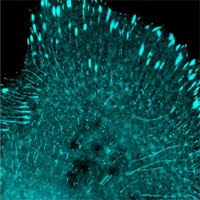
    Cells infected with lentivirus carrying mWasabi. Lentivirus carrying LanYFP will make most cells much more brighter than this.
2-3 times brighter than EGFP, no cytotoxicity detected
The mWasabi is stimulating
The brightest green fluorescent protein with excellent photostability, carried on 10e8 TU/ml high titer lentivirus.
    The LanFPs express well in bacteria.
Reminding you of icecream
The LanFPs express well in bacteria
Project planning is under way to test the cytotoxicity of lanFPs in different mammalian cell lines and in vivo with a focus on neurons.
    The FPs fold so strongly that they fluorescence even in SDS-PAGE.
Fluorescence while running in denaturing gel
Can you see the FP bands in the SDS PAGE?
    FPs in SDS PAGE–a closer look
while the gel is still running
Can you see them now?
    FPs in gel cassette over UV lights
Easier to see now than during gel running
Invincible FPs
    FPs in gel cassette under blue LED
The red FP is harder to see because of the black background
Fluorescence in SDS page under blue LED
The purified FPs can be used as “real time” protein markers.
New Product of the Week 07/26/10-08/01/10: pCHAC-mWasabi-C for expressing mWasabi fusion through retroviral vectors.
Promotion of the Week 07/26/10-08/01/10: Get 3′ TAMRA & BHQ oligo mods for $45 ea & 3′ Dabcyl mod for $20 50 nmol syn scale only/while supplies last- use dbtkrm0726

Saturday, May 29, 2010

Lentiviruses expressing constitutively active or dominant negative versions of genes in signaling pathways

NF-kB (nuclear factor kappa-light-chain-enhancer of activated B cells) refers to a protein complex functional in signaling pathways, particularly in response to stress stimuli. There are two signaling pathways leading to the activation of NF-kB signaling, known as the canonical (or classical) pathway, the non-canonical (or alternative) pathway. (from AlleleBlog)

In the canonical NF-kB pathway, NF-kB dimers such as p50/RelA are maintained in the cytoplasm by interaction with an independent Inhibitor of NF-kB (IkB) molecule. When the upstream signaling is active, an IkBa kinase (IKK) complex consisting of catalytic kinase subunits IKKa and/or IKKb and the scaffold protein NEMO will be recruited to the cytoplasmic adaptor of certain cell surface receptor and stay activated. Activation of IKK complex will consequently phosphorylate the IkB at two serine residues, which induce the proteasomal degradation of IkB. Released from IkB, NF-kB dimers then translocate into the nucleus and bind with a consensus sequence (GGGACTTTCC) of various genes and thereby activates their transcription. In a negative feedback loop, NF-kB activation also leads to the expression of the IkB gene, which subsequently sequesters NF-kB subunits and terminates transcriptional activity unless a constitutive activation signal is present.

The non-canonical pathway is mainly for activation of p100/RelB complexes during B-and T-cell development, where NF-kB was first discovered. Different from the canonical pathway, 1) only certain receptor signals (e.g., Lymphotoxin B, B-cell activating factor, CD40) can activate this pathway, 2) it proceeds through an IKK complex that contains two IKKa subunits (but not NEMO) and 3) receptor binding leads to activation of the NF-kB-inducing kinase NIK, which phosphorylates and activates an IKKa complex, the latter in turn phosphorylates two serine residues adjacent to the ankyrin repeat C-terminal IkB domain of p100, leading to its partial proteolysis and liberation of the p52/RelB complex.

Other distinct NF-kB pathways undoubtedly exist. For example, p50 (or p52) homodimers enter the nucleus, where they become transcriptional activators by virtue of interaction with the IkB-like co-activator Bcl-3 (or IkBz). How these are regulated is not known.

There are many ways of applying reagents that can manipulate the NF-kB system for drug screening as well as basic research. For this reason, Allele Biotech is introducing a set of lentiviruses as listed below. The way this product group is operated is that the Allele will publish the design and specifics of the products, but will produce it upon the first order. The person who places the first order will need to wait for 3-5 weeks for receiving the products, but will receive a 40% discount and an opportunity to provide input to the product design. The platform for lentiviral products is based on our field-leading high titer lentivirus packaging capabilities, and you can rest assured that high quality lentivirus will be produced at a pace much faster and lower price than if you were to make them by your own lab or find them from anywhere else. Allele Biotech will introduce more such products in the fields of miRNA (to provide all ~800 human miRNA and their anti-miRNA silencers on virus), cell differentiation lineage-specific promoter-FP reporters, etc. We now call these products the Lead Products. Cost effectiveness is just the beginning. Imagine how our ingenuity and innovation can pave the way for your research.

1) HiTiter IkBa Expression Lentiviral Particles: can be used in functional studies of IkBa’s roles in NF-kB signaling. Overexpression of IkBa will eliminate the low-level activation by factors in the cell culture medium or other fluctuations to ensure that any change in NF-kB signaling is caused by the stimulus being tested.
2) HiTiter Dominant Negative IkBa Expression Lentiviral Particles: Dominant Negative IkBa has serine-to-alanine changes at residues 32 and 36. It can be used to repress the expression of endogenous IkBa or block NFkB signaling in certain cell lines.
3) HiTiter IkBa-RFP Fusion Expression Lentiviral Particles: This is a reporter suitable for the studying proteasomal degradation of IkBa after phosphorylation.

4) HiTiter IKKa Expression Lentiviral Particles: can be used in functional research for the role of IKKa in NF-kB signaling.
5) HiTiter Constitutively Active IKKa Expression Lentiviral Particles: Constitutively active IKKa has serine-to-glutamate mutations at residues 176 and 180.
6) HiTiter Dominant Negative IKKa Expression Lentiviral Particles: Dominant negative IKKa is mutated by serine-to-alanine at residues 176 and 180.

7) HiTiter IKKb Expression Lentiviral Particles: can be used in functional research for the role of IKKb in NF-kB signaling.
8) HiTiter Constitutively Active IKKb Expression Lentiviral Particles: Dominant negative IKKb is mutated by serine-to-glutamate at residues 177 and 181.
9) HiTiter Dominant Negative IKKb Expression Lentiviral Particles: Dominant negative IKKb is mutated by serine-to-alanine at residues 177 and 181.

10) HiTiter pNFkB-Luciferase Lentiviral Particles: a cis-reporter plasmid containing the luciferase reporter cDNA linked to five repeats of an NF-kB binding site.
11) HiTiter pNFkB-GFP Lentiviral Particles: a cis-reporter plasmid containing the GFP reporter gene linked to five repeats of an NF-kB binding site.

New Product of the Week 05-23-10 to 05-31-10:

Cre recombinase fused to mWasabi GFP carried on lentivirus, ABP-RP-Cre2AGL, or ABP-RP-Cre2AGS

Promotion of the week 05-23-10 to 05-31-10:

actually 3 promotions this week, first announced to Allele fans and friends on Facebook: 10% off the brand-new RFP-Trap ACT-CM-RFA0050 for co-IP with mCherry, mPlum, mOrange…Order by Monday to qualify for discount! Free sample for FAM-amidite for oligo cores at universities that make qPCR and other probes. Free sample of high attachment tissue culture plates that use 40% less plastics (made in Canada)

Friday, January 29, 2010

Monitoring the Undifferentiated Stage of Stem Cells—the Pluripotency Markers

Human embryonic stem (ES) cells or induced pluripotent stem (iPS) cells promise to serve as an unlimited source for transplantation or tissue-specific differentiation. However, obtaining and maintaining stem cells are very difficult tasks for multiple reasons. For instance, most stem cell lines tend to spontaneously differentiate in culture, and even if the cells form stem cell-like colonies, they may be of a heterogeneous population.

To identify pluripotency of stem cells, expression of stem cell-specific marker genes (i.e. Oct-3/4, Sox2, Nanog, Rex-1) is monitored by RT-PCR. Alkaline phosphatase activity and methylation profiles of promoters of pluripotency-relevant genes are often analyzed as well. Compared to murine cells, it is noticeably more difficult to obtain human iPSCs, of which stem cell-like colonies sometimes turn out not to be pluripotent cells. We highly recommend testing iPSCs, especially human iPSCs, with antibodies against stage-specific embryonic antigens such as SSEA-3, SSEA-4, TRA-1-60, and TRA-1-81.

Clink here to read what research reagents are available from Allele Biotech

New product of the week 01-25-10 to 01-31-10:

All-In-One-Vector: Human OSKM Lentiviral Paticles, with Oct-4, Sox-2, Klf, and c-Myc all expressed from a single virus, ready-to-use.

Promotion of the week:

human iPS cell detection primer set, the same as the landmark Yamanaka paper [4] on creating human iPS for the first time.

Friday, October 30, 2009

Commonly Known Facts About Viral Packaging -That Might Not Be Correct…

Packaging lentiviruses or retroviruses is not a routine procedure that every biology lab performs even if there is need to use it. A viral packaging protocol normally begins with preparation of purified transfer plasmid DNA, a miniprep should be enough for a few transfections. The virus backbone plasmid is either co-transfected into commonly used cells with helper plasmids that provide the essential proteins required for particle packaging, or transfected into established helper cell lines that express the required proteins from integrated transgenes. After incubation of packaging cells for a couple of days, viruses are collected and tittered. Titer determination is somewhat tricky for the inexperienced. Using a control virus expressing a fluorescent protein can make this step convenient.

Commonly known facts:

1) Lentiviruses are packaged at a titer of 10^6 IU/ml without concentrating steps.

This needs update since with more advanced technologies lentiviruses can be packaged routinely at 10^8 IU/ml. With further concentrating, the titer can be easily above 10^11 IU/ml. Retroviruses can be packaged to similar titers as well.

2) Using packaging cell lines gives the highest possible titer

While packaging cell lines (such as Allele’s popular Phoenix Eco and Ampho cells for retrovirus packaging) provides maybe the most convenient method for packaging, the yield will not reach the highest potential. Packaging cell lines may also lose their capability for packaging after continued culturing, requiring periodic selection with antibiotics and functional tests, as we do here at Allele.

3) Retroviruses are always collected in one shot after transfection into packaging cells

If the transfer vector has oriP/EBNA1 episomal maintenance system, such as some of the Phoenix vectors Allele offers, the plasmids may continue to express for up to 30 days. With puromycin selection, the titer of retrovirus produced from Eco or Ampho cells can reach 10^7 IU/ml.

This week’s promotion (102509-103109): 10% off across the board of Allele Biotech’s custom services, for an example, check out our world-leading baculovirus protein expression.

New Product/Service of the Week: Introduction of Custom Viral Packaging Service. Routine titer of 10^8 IU/ml, as high as 10^10 IU/ml, option to include cloning. Signature service ABP-CS-MERV002 provides more than 200 million particles at $7/million particles. These are game-changing prices for the viral packaging service market based on superior technologies!